
Trump allies push to sideline AI safety advocates as fight over oversight grows
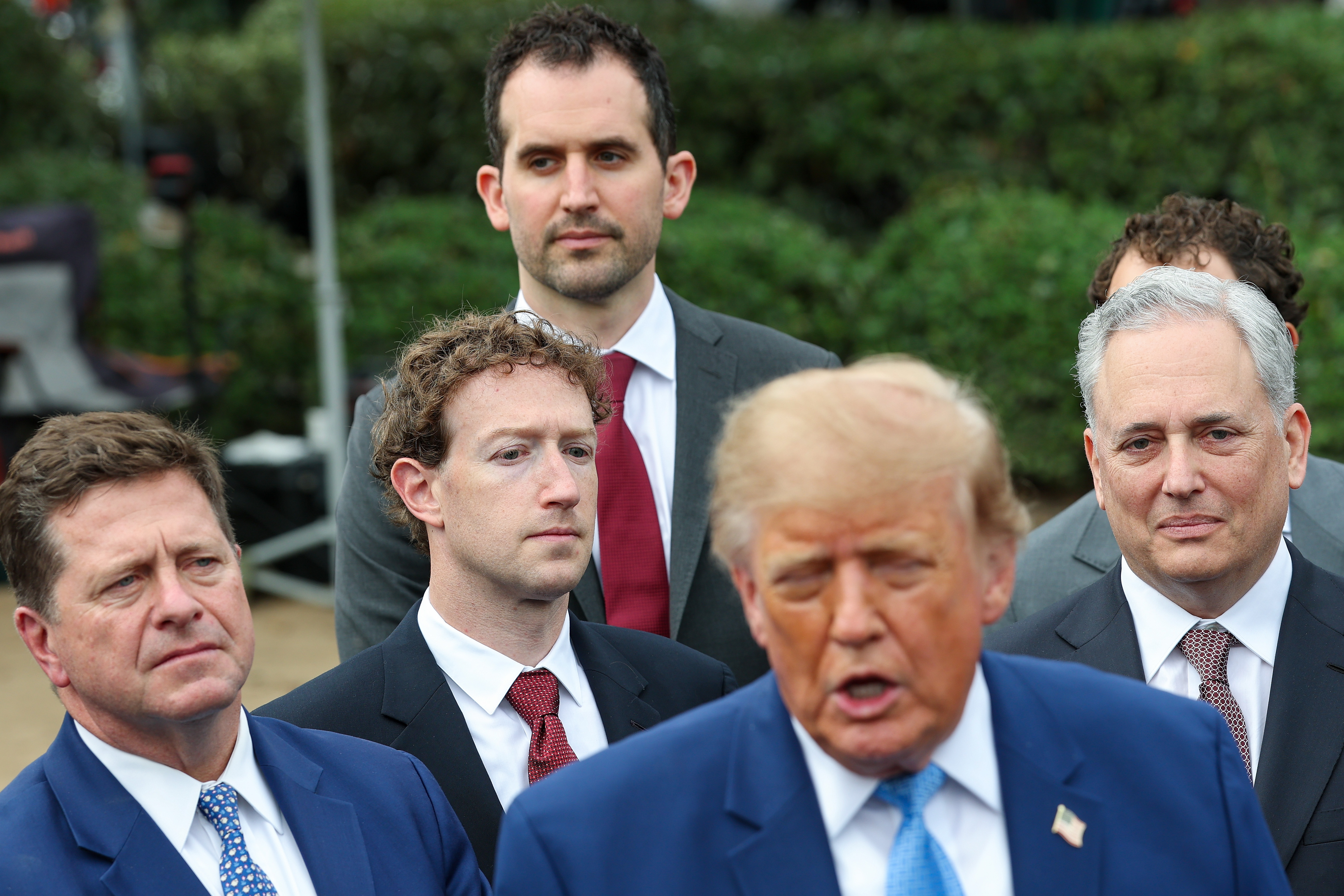
BERKELEY, Calif. - After artificial intelligence safety advocates captured Washington's attention with dire warnings about the technology's power, the Trump administration and its allies embraced some of their suggestions, while moving to sideline the advocates themselves.
Battle lines have been drawn in recent days over part of an accord signed by President Donald Trump and AI chief executives last week: Who should audit AI companies' systems to ensure their technology behaves as intended.
Leading AI companies - including OpenAI and Anthropic - have for years worked with a cluster of nonprofits concentrated in the Bay Area's AI safety community, which grew out of the effective altruism movement. But Trump's tech-world allies say the work of auditing AI should be taken on by America's largest consulting firms.
"In my view they should be professional auditors, not these NGOs," investor and former top White House AI adviser David Sacks said on his All-In podcast last week. He said in a post on X last month that the AI safety nonprofit METR, which has worked with Anthropic, was too close to the company to be called independent. Soon after, Anthropic said it would partner with consulting giant Accenture to build a team of outside evaluators.
At a conference here over the weekend, members of AI safety organizations grappled with the impact of what some see as a coordinated campaign to delegitimize their work and paint their community as cultish and unserious. The event took place at a former hotel popular with AI safety acolytes that also recently hosted a conference on AI consciousness and a sex workshop called "Slutcon."
Trump officials and allies have sniped at the movement for months but the attacks intensified after public anxiety over AI risks forced the White House to respond. Sacks last month shared on X a New York Post front page that called employees of METR, which helped OpenAI investigate its rogue AI agents, "THE WOKE WIZARDS OF AI." (The Washington Post has a content partnership with OpenAI.)
Trump on Sunday named several figures who have rejected calls from advocates for an AI industry-wide slowdown to his Super Intelligence Force advisory panel. They include Sacks and Emil Michael, the Pentagon's chief technology officer, who said last month that calls for action to prevent extreme scenarios of AI causing harm promoted "extinction, death-cult-like philosophies."
"There has absolutely been a rhetorical push within certain corners of the White House and broader Trump administration to get the message out about effective altruism and its potential dangers," said a Trump administration official, speaking on the condition of anonymity to describe private discussions.
A White House official said that it supports organizations that evaluate the security and safety of how AI models are engineered. The official pointed to Trump's 2025 executive order targeting what the president termed "woke AI."
Anthropic declined to comment.
Nathan Leamer, director of the pro-industry nonprofit Build American AI, said he has been briefing congressional staff and other influential conservative figures in Washington about effective altruism, describing it as antithetical to his own Christian values.
"A year ago no one in Hill offices knew what effective altruism was," Leamer said. Build American AI is linked to Leading the Future, a political campaign group funded by the venture capital firm Andreessen Horowitz and OpenAI President Greg Brockman, a major midterms Republican donor.
Brad Carson, co-founder of Americans for Responsible Innovation, which says it is focused on AI policy in the public interest, said that Trump allies are trying discredit anyone pushing for meaningful AI regulation, an idea that now has significant momentum.
"In D.C., at least, and maybe in the broader culture, we won that fight. The vibe is with us," said Carson, who also leads a political advocacy organization funded in part by Anthropic. "People are very concerned. Congress wants to regulate."
But leaders of AI evaluation start-ups that did not grow out of the AI safety movement said some Washington Republicans are distrustful of the label.
"It almost felt like a new version of McCarthyism," said Rayan Krishnan, CEO of the Andreessen Horowitz-backed start-up Vals AI, after a trip to Washington last month to pitch his start-up to the public sector.
Judd Rosenblatt, CEO of AE Studio, who described himself as a conservative small business owner, said multiple people in the Trump administration have told his team that they see the need for third parties to assess AI tools, but are wary of effective altruism, he said.
Civil society groups that have been auditing AI systems since before the debut of ChatGPT warn there is a risk that an opportunity for oversight of opaque AI giants will be squandered.
"Where we find ourselves now is trying to determine who will actually be in the room in making decisions," said Miranda Bogen, chief technologist at the Center for Democracy & Technology and director of the advocacy group's AI Governance Lab, one of various groups eager to contribute their expertise in standard-setting.
The accord signed by AI chief executives last week, which Trump called "morally binding," was frequently mentioned onstage and in huddles between sessions at the Berkeley conference last weekend, where attendees endured a heat wave with fans and Popsicles.
At a Sunday discussion panel on what the AI auditor ecosystem might look like, one speaker said they are working on building a broad coalition of experts, including people working on bias and discrimination as well as blue-chip firms like Accenture and Deloitte. Another urged the community to find ways to prove its legitimacy. Another suggested two-month boot camps to train a talent pipeline of qualified auditors.
Adam Gleave, CEO of FAR.AI, a nonprofit research institute, said in an interview that excluding the AI safety community would shut out people with expertise that are important in the current moment.
"When it comes to looking at millions of agent transcripts and trying to piece together what they did and how they were interacting, I don't think there are many organizations in the world that have that expertise," Gleave said. "The reality is that anyone you hire with that background is going to have some connection to the industry."
On his podcast, Sacks and his co-hosts, who remain close to the White House, made clear that they preferred instead to have established corporate giants do the work.
"You're going to see EY in short order here announce something," said investor Chamath Palihapitiya, who earlier in the episode said his start-up 8090 was building the global accounting firm formerly known as Ernst & Young "an entire audit infrastructure for super intelligence," and that 8090 now plans to "roll it out to everybody."
EY said in a statement that it was working with 8090 to "develop new capabilities that bring greater visibility, traceability and human accountability to consequential AI-enabled decisions and workflows."
Related Content
This article originally appeared on Washington Post at https://www.yahoo.com/news/politics/articles/told-world-ai-dangerous-now-092510605.htmlWhat's Your Reaction?
 Like
0
Like
0
 Dislike
0
Dislike
0
 Love
0
Love
0
 Funny
0
Funny
0
 Wow
0
Wow
0
 Sad
0
Sad
0
 Angry
0
Angry
0


Comments (0)