
What needs to happen for Democrats or Republicans to win control of the House
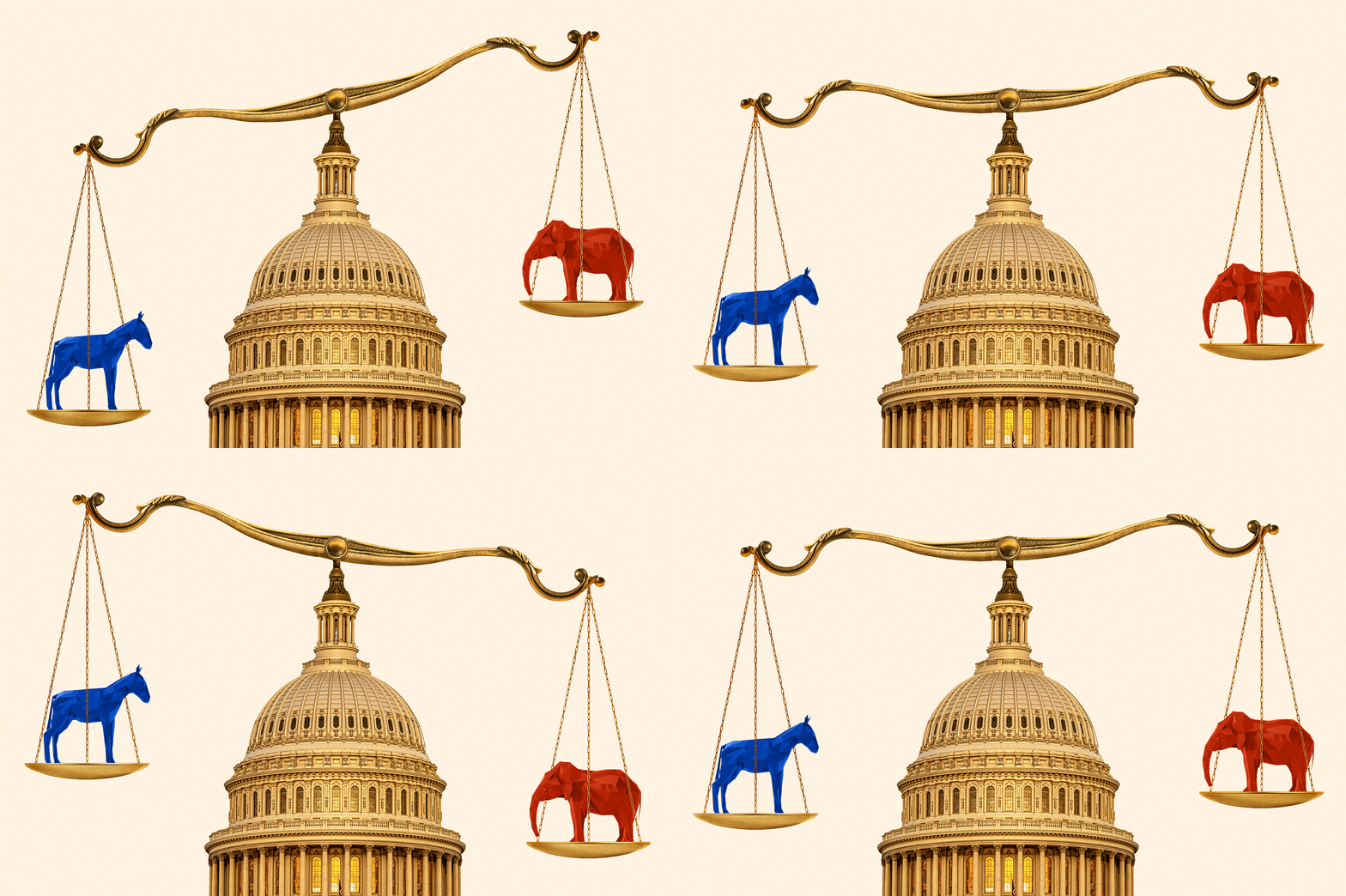
It's crunch time. With less than a month to go until the 2026 midterm elections, Democratic and Republican candidates for the U.S. House of Representatives nationwide are making one last push to persuade voters in their districts — and help their party win or retain control of the chamber on Nov. 3.
The stakes are high. President Trump has enjoyed complete Republican control of Congress for the first half of his second term. Flipping the House would give Democrats the power to block parts of the president's agenda, investigate his administration and even impeach him (again).
Historically speaking, a president's party almost always loses seats when voters return to the polls to judge his first two years in office. (The average number lost since World War II? Twenty-six.) Sometimes, the backlash is so pervasive that the president's party loses seats across a wide range of competitive districts — a phenomenon known as a "wave" election.
But the past doesn't necessarily predict the future, and Republicans have certain advantages today that they didn't have before. Here's what needs to happen for each party to come out on top.

The races to watch
The first thing to know about any House election is that while all 435 congressional districts are technically up for grabs, roughly 83% of those contests (representing about 360 seats) are not considered competitive.
House incumbents have always had huge advantages: money and name recognition, mostly. But their head start has only widened in recent years as partisan polarization and redistricting have helped make the vast majority of congressional districts "safe" for one party. These days, incumbents tend to focus more on fending off primary challengers. The general election can be a breeze in comparison.
As a result, this year's true battleground is relatively small. According to the nonpartisan Cook Political Report's "race ratings," just 21 contests are genuine "tossups" at this point. Another 12 "lean Democratic," and 9 "lean Republican." There's also a third competitive category that includes 16 seats where Democrats are the "likely" winners, and 18 seats where the same could be said about Republicans.
That's 76 competitive districts — again, out of 435.
It's clear from looking at this year's ratings which party is playing more defense and which is playing more offense — and where. Six Democratic seats are too close to call; two more lean Republican; another three are likely to break for the GOP; and three are rated solidly Republican. That's a total of 14 potential blue-to-red flips for Democrats to worry about.
Republicans, by contrast, have to worry about 25 red-to-blue flips — including a full 15 in the tossup category.
Geographically, this year's tossups are concentrated in certain kinds of places: Rust Belt districts in states that have swung from party to party in the past (such as Michigan, Pennsylvania and Ohio); Mid-Atlantic suburbs (in states such as New York, Virginia and North Carolina) where Trump has scrambled some of the usual coalitions; and Sun Belt districts (think Florida, Texas, California and Nevada) where Latinos factor heavily. Trump carried many of these areas in 2024.
Overall, the map gives Democrats more pickup options — which could mean more paths to a House majority.
The path to a Democratic House
Senate and governor contests can be quirky — more state-specific and personality-driven. But national dynamics tend to play a larger role in shaping the composition of the incoming House.
So it's not just a matter of who has more targets on the board. It's that the board itself tends to tilt to one side or the other, taking most of those targets with it. A recent example was the 2010 midterm election, when impatience with America's slow recovery from the 2008 financial collapse and frustration with President Barack Obama's response helped Republicans gain 64 House seats.
Beyond the history of midterm backlash against the president's party, Democrats have two big advantages right now. One is that the current Republican majority is so minuscule — just 219 votes to 214, including an independent who caucuses with Republicans — that Democrats only need a net gain of three seats to win back the House.
The other is that the board seems to be tilting in Democrats' favor — assuming the polls are right.
Surveys suggest there's one underlying factor pulling the national electorate to the left: dissatisfaction with Trump. According to the data journalists at Silver Bulletin, 60% of Americans, on average, currently disapprove of how Trump is handling his job compared with 37% who approve. That puts the president's net disapproval rating at about 23 percentage points.
Trump is earning even lower marks on voters' top issue this year: the cost of living. Shortly after he returned to office, roughly equal numbers of Americans approved and disapproved of how the president was handling inflation. But today — as tariffs and the Iran war help drive prices up — 72% disapprove and 24% approve. That's a 48-point gap.

Democrats aren't particularly popular. But for the party in power, it may be hard to overcome this level of dissatisfaction with the status quo. That's why, when pollsters ask their so-called generic ballot question — If an election for U.S. Congress were held today, which party's candidate would you vote for in your district? — Americans are currently giving Democrats a substantial lead of about 9 percentage points, on average.
Making matters worse for Republicans, that lead has grown over the last month as some voters who favored Trump in 2024 — including some Latinos and independents — say they're planning to vote Democratic. Over the last two weeks, Cook has shifted 33 of its race ratings toward the Democrats as well.
To put a 9-point lead in perspective, Democrats were leading by an average of 7 points on the generic ballot at this point in 2018, with Trump as president and Republican majorities in the House and Senate. Four weeks later, they picked up 41 seats and flipped the House.
If the polls are right, Democrats might win control of the House again.
The path to a Republican House
But are the polls right? In recent days, Republicans have pointed to some surprising survey results on the Senate side — including Democratic leads in rural red states such as Iowa, Kansas and Nebraska — to argue that pollsters might be misjudging public sentiment.
They're not wrong to say the polls have missed in the past. Polling errors are commonplace; they happen in most elections. But they tend to be random and to change directions from one cycle to another. The Trump era has been a little different. In each of the three presidential contests that Trump himself has competed in, the final average of polls conducted before Election Day underestimated Republicans' performance in the popular vote by an average of 3.8 percentage points, according to data journalist Nate Silver.
The theory is that a phenomenon called nonresponse bias — in which Democratic voters are more eager or available to respond to pollsters than Republican voters — might have made Democratic support look stronger than it actually was.
Pollsters try to adjust for this by weighting their results — that is, using statistical methods to give less weight to respondents who are overrepresented demographically and more weight to respondents who are underrepresented demographically. But it's difficult to predict in advance who will show up on Election Day.
This time around, there are signs that rural Republicans are not responding to pollsters in certain states.
Could that mean Republican candidates in those places will outperform their polling? Possibly. But experts say it may also mean that rural Republicans are less supportive of the GOP than they were in 2024 — potentially voting Democratic or staying home on Nov. 3.
After all, there's been virtually no polling bias toward Democrats in Trump era elections when Trump himself wasn't on the ballot. In fact, the polls since 2016 have overestimated Republican support in midterm elections (by an average of 0.2%) and off-year, special and runoff elections (by an average of 1.3%), according to Silver.
Either way, pollsters aren't seeing signs of this rural effect in most states — and even if they were, it might make only a minor dent in Democrats' 9-point national lead.
Redistricting is the other Republican advantage. House redistricting efforts typically take place every 10 years, after each new census reveals changes in population distribution. But last summer, Trump successfully pushed GOP legislators in Texas to pass new congressional district boundaries five years earlier than normal to help Republicans win five additional House seats in 2026. This kicked off a tit-for-tat cycle that saw nine states adopt new congressional maps for the midterms — some to benefit Democrats, others Republicans.
Now that the dust has settled, Cook projects that Republicans could win nine seats because of redistricting (in Alabama, Florida, Louisiana, North Carolina, Ohio, Tennessee and Texas), while Democrats could win five (in California and Utah). That would net the GOP four seats overall.
It's not what Republicans initially hoped to gain from gerrymandering. "We're not gonna win all 13 of those redistricted seats. That's correct. We're not," GOP House Majority Whip Tom Emmer of Minnesota told Axios recently. But it's also not nothing.
The hope for the GOP is that some combination of polling error and redistricting boost — along with a late influx of hundreds of millions of dollars to help defend districts Trump won in 2024 — will be just enough to preserve their slim House majority.
This article originally appeared on Yahoo News at https://www.yahoo.com/news/politics/article/what-needs-to-happen-for-democrats-or-republicans-to-win-control-of-the-house-165959466.htmlWhat's Your Reaction?
 Like
0
Like
0
 Dislike
0
Dislike
0
 Love
0
Love
0
 Funny
0
Funny
0
 Wow
0
Wow
0
 Sad
0
Sad
0
 Angry
0
Angry
0


Comments (0)