
Trump says Russia 'has been fine on Ukraine' as he makes deals with Putin
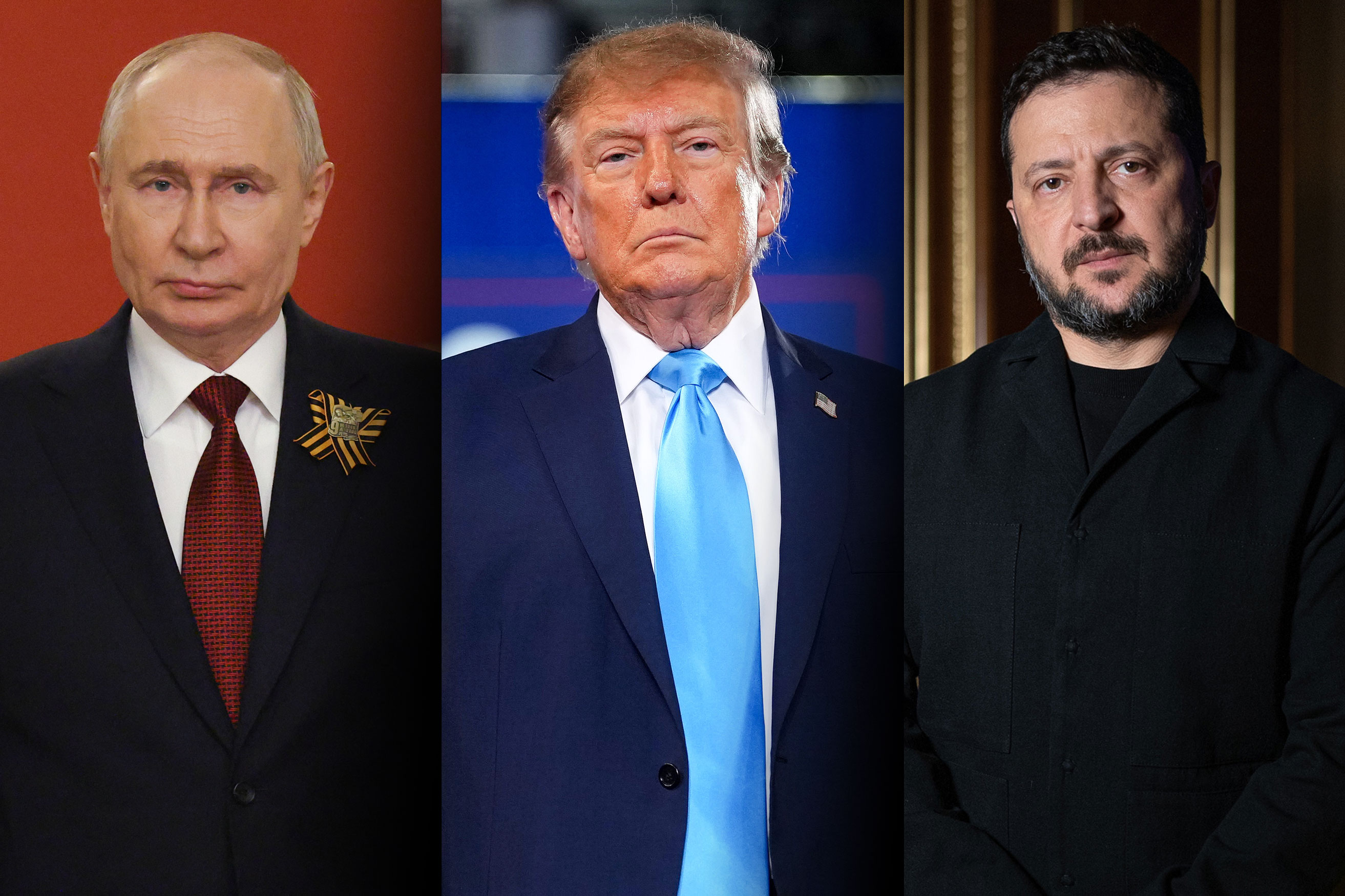
A series of Trump administration moves over the last two weeks — including decisions to lift sanctions on Russian diesel and delay other measures targeting the Russian economy — have led both Republicans and Democrats to question whether President Trump is changing course and siding with Russian President Vladimir Putin over Ukrainian President Volodymyr Zelensky in the war between their two countries.
"Russia, frankly, has been fine on Ukraine," Trump told reporters on Monday. "They haven't been doing much."
In contrast, the president continued, "We've given a lot to Ukraine. They've given nothing to us. Remember that."
Russia and Ukraine have been at war for more than 12 years. But in February 2022, the conflict entered a new, deadlier phase when Putin launched a full-scale invasion of Ukraine and tried to seize territory. The fighting has since become a grinding war of attrition. The United States has generally supported Ukraine, even as direct military aid has waned during Trump's second term.
The administration's latest steps, however, "amount to a major reversal in U.S. strategy," the New York Times reported on Sunday. "The breach with Ukraine has been sudden and perhaps irreparable."
So what's going on here? Posting Sunday on social media, Trump defended his actions by insisting that he is "in the process of negotiating Peace in the war between Russia and Ukraine" and doesn't "want to do anything that will drive, foolishly, Russia away from the bargaining table." Ukraine, he said, is targeting diesel refineries in Russia, which is "hurting the world diesel markets, including those in the United States." He said that "farmers, ranchers, and businesses of all kinds are suffering greatly from this, but Russia is, nevertheless, sending, at a low price, millions of barrels of diesel to the World."
But even Republicans have pushed back. "I think it's clear Russia is the aggressor, and we've got to do everything we can to put economic pressure on Russia," GOP Sen. Rick Scott of Florida told the Associated Press over the weekend. "So it's not the first thing I would be doing."
When Zelensky was asked last week if he believed Ukraine was "losing" the U.S., he replied: "Yes."
"It's painful when President Trump chooses one side, not our side," Zelensky said.
On Tuesday, Trump's special envoy Steve Witkoff met with Zelensky in Oslo, Norway. Trump's son-in-law, Jared Kushner, participated via video link. On Wednesday, Witkoff and Kushner will reportedly fly to St. Petersburg, Russia, to meet Putin in his hometown with "an updated set of [peace] proposals," according to the BBC.
Is a diplomatic breakthrough in the offing? Here's what you need to know about the latest developments.
What's changed in recent days
Oct. 9: Trump said he had reached an agreement with Putin to supply diesel to the U.S. and global markets. Minutes later, the Treasury Department announced that it would be lifting sanctions on Russian diesel exports through April 2027. Those sanctions — which limited Putin's ability to bankroll the invasion of Ukraine — have been in place since 2022.
"Diesel Prices for Americans and, indeed, the World, will be COMING DOWN, IN RECORD NUMBERS, AND FAST!" the president wrote on social media.
Oct. 10: Trump blamed Zelensky for high U.S. diesel prices and said Ukraine should replace him. "He wants to make problems for the world. He wants to make problems for our farmers, our ranchers, with diesel fuel," Trump told reporters before leaving for a campaign rally in Tennessee. "I suggest they get a new leader who can make a deal because he could have made many deals and for some reason he never does."
Oct. 11: On social media, Trump declared an "ENERGY CEASEFIRE in the War between Russia and Ukraine." He claimed that "both parties have agreed." Zelensky said the agreement was news to him, but added that he would be willing to pause attacks on Russian oil refineries if Russia pauses attacks on Ukraine's electrical grid and other energy infrastructure in return.
Oct. 11-14: For three days, Zelensky held his fire on Russian oil refineries. Meanwhile, Putin continued to bombard Ukraine's energy infrastructure, leaving hundreds of thousands of Ukrainians without power ahead of winter. The Trump administration clarified that its "energy ceasefire" applied solely to attacks on oil refineries, but Ukraine doesn't have any fully operational oil refineries — Russia has repeatedly attacked and disabled the last one in recent years.
Oct. 14: Ukraine discovered that its access to Elon Musk's Starlink satellite communications network — as well as Starshield, its military-grade counterpart — had been throttled, limiting its ability to defend itself from Russian ballistic missile attacks on energy infrastructure. "Right at the moment Trump was warning Zelensky not to attack Russian refineries, the Starshield settings were somehow altered, such that the system could not track objects traveling at speeds greater than about 100 miles per hour — woefully inadequate to detect Russian aerial assaults," the National Review explained.
Citing four sources familiar with the discussions, the Telegraph reported that "Elon Musk approached Donald Trump with the idea of slowing down Starlink in Ukraine" and that Trump "agreed." In response, Trump denied any involvement, saying, "I don't know if it was anybody, but it wasn't me, and I don't think it was Elon." Musk wrote on social media that "Starshield systems are owned and controlled by the US government. Any limits on speed or usage are decided by the US military and ultimately POTUS."
Reuters also reported that the "order to limit Starshield for Ukraine came from inside [the] White House." The Wall Street Journal reported this week that “Elon Musk ordered the slowdown” — “a decision that sparked panic in Kyiv and confusion inside the Trump administration.”
Oct. 15: Zelensky said that Ukraine would resume attacking Russian oil refineries. "That's it," Zelensky told the Financial Times. "The block is out. We're done."
Oct. 16: Trump issued an executive order waiving new sanctions against Russia — as well as tariffs on major buyers of Russian energy — that would have taken effect under the bipartisan Graham Act that he signed in September. "I'm not a big fan of Zelensky," Trump told Newsmax. "I find Zelensky to be more difficult to deal with than Putin."
Oct. 18: Trump wrote on social media that his "decision on Russia is a very simple one" aimed at striking a peace deal and lowering energy costs for Americans.
"Great progress is being made, and that includes current hostage negotiations," Trump claimed, saying that he doesn't "want to do anything that will drive, foolishly, Russia away from the bargaining table."
He continued, "Russia is doing very little, if anything, to help the Islamic Republic of Iran, compared to what they could be doing, and I want to keep it that way, and will, unless stupid people get in the way."
In contrast, Trump claimed Zelensky "doesn't want to end this war, and probably never did."
Oct. 19: Citing "a U.S. official and three additional people familiar with the situation," the Washington Post reported that the Trump administration is holding up "the transfer of interceptor missiles to Ukraine that are needed to protect the country from Russian missile and drone attacks."
Around the same time, Trump criticized Zelensky again, saying, "It's time for somebody else to negotiate on behalf of Ukraine."
Oct. 20: Witkoff and Kushner met with Zelensky in Oslo. According to the BBC, Zelensky suggested after the meeting that "crucial issues of early warning of Russia's ballistic missile strikes had… been resolved." Zelensky also said that he discussed Ukraine's access to missiles and Starlink with U.S. Secretary of State Marco Rubio — and he expected "good results."
Will Trump's deals with Putin lower U.S. diesel prices?
Trump has accused Zelensky of "knowing that these attacks" on Russian refineries "are seriously hurting the world diesel markets, including those in the United States."
It's true that the price of diesel is up about 77% so far this year — putting it near record highs and raising costs for American farmers, truckers and businesses (which in turn puts upward pressure on the price of consumer goods and services).
But energy analysts say the Iran War, not Ukrainian attacks on Russia, is the major reason diesel is so much more expensive than it used to be. "The main issue is still the Strait of Hormuz, that there is not enough diesel coming out of the Strait of Hormuz," one recently told the New York Times.
In 2025, Russian diesel exports accounted for roughly 9% of the global diesel trade — or about 700,000 barrels a day, according to S&P Global Energy. That number has fallen to about 140,000 barrels a day since Ukraine started targeting Russian oil refineries.
Trump's deal with Putin would amount to another 75,000 barrels a day, according to the New York Times.
That's not nothing — but experts say it's also not enough to make a huge price difference in the U.S. To put those 75,000 barrels in perspective, diesel exports from Saudi Arabia and other Middle Eastern countries have fallen by 800,000 barrels per day since the start of the Iran war in February.
Patrick De Haan, head of petroleum analysis at GasBuddy, estimated in an Oct. 9 social media post that Trump's deal with Russia could eventually lower the cost of diesel by 10 to 20 cents per gallon. Ryan Sweet, chief global economist at Oxford Economics, likened the impact to "putting a Band-Aid on a gunshot wound."
And that's assuming Russia can deliver. According to the Times, "many analysts consider [even] those numbers to be unrealistic because roughly 40 to 50 percent of Russian refining capacity is offline" — and "repairing and restarting refineries can take months or years in the best of circumstances."
Trump has been taking various steps to try to lower U.S. gas prices ahead of November's midterm elections, including signing an executive order allowing tax-free purchases of red-dyed off-road diesel. But an October AP poll found that only 17% of U.S. adults approve of how the president is handling the cost of living — and 65% now blame his policies for persistently high prices more than factors beyond his control.
Will Trump's deals with Putin end the war?
On Sunday, Energy Secretary Chris Wright described Trump's diesel deal as a "carrot" to get Russia to ease its assault on Ukraine.
It's an "incentive to Russia, that if they can reduce the conflict with Ukraine, they can get an energy ceasefire or reduce the conflict such that they have diesel to export, we'll allow it to flow to world markets," Wright told ABC News.
The Times has also reported that the "Trump administration's talks with Russia about ending the war in Ukraine have expanded to include a multibillion-dollar oil deal that would benefit Middle Eastern business executives with ties to the two main U.S. negotiators, Steve Witkoff and Jared Kushner."
"The deal, which is contingent on approval from the U.S. government and the Kremlin, is for a sprawling set of oil fields, refineries and gas stations around the world owned by Lukoil, one of Russia's biggest energy companies," the paper added.
Meanwhile, at their talks in Oslo on Tuesday, Witkoff and Kushner were expected to tell Zelensky that "holding out to retain occupied portions of the country's eastern provinces is not worth it — and that there is money to be made for Ukraine, as well, if it would only drop its objections to an accord, even one written largely on Russia's terms," according to the Times.
In short, the Trump administration appears to be pushing harder than ever before to force Ukraine to cede sovereign territory to Russia as part of a negotiated end to the war.
Whether Zelensky succumbs to that pressure remains to be seen. "I believe steps have been taken to convince Ukraine to capitulate," he told Bloomberg in an interview published on Sunday. "I don't want to think that our American partners believe the war could be ended sooner at Ukraine's expense. But that's how it looks."
"If the United States will support Putin — it's unbelievable, it's a tragedy," Zelensky added Sunday on NBC News's Meet the Press. "If these two countries will be together, of course we will not prevail. And we will not be able to stand."
This article originally appeared on Yahoo News at https://www.yahoo.com/news/world/article/trump-says-russia-has-been-fine-on-ukraine-as-he-makes-new-deals-with-putin-will-his-strategy-pay-off-202502585.htmlWhat's Your Reaction?
 Like
0
 Dislike
0
 Love
0
 Funny
0
 Wow
0
 Sad
0
 Angry
0


Comments (0)